
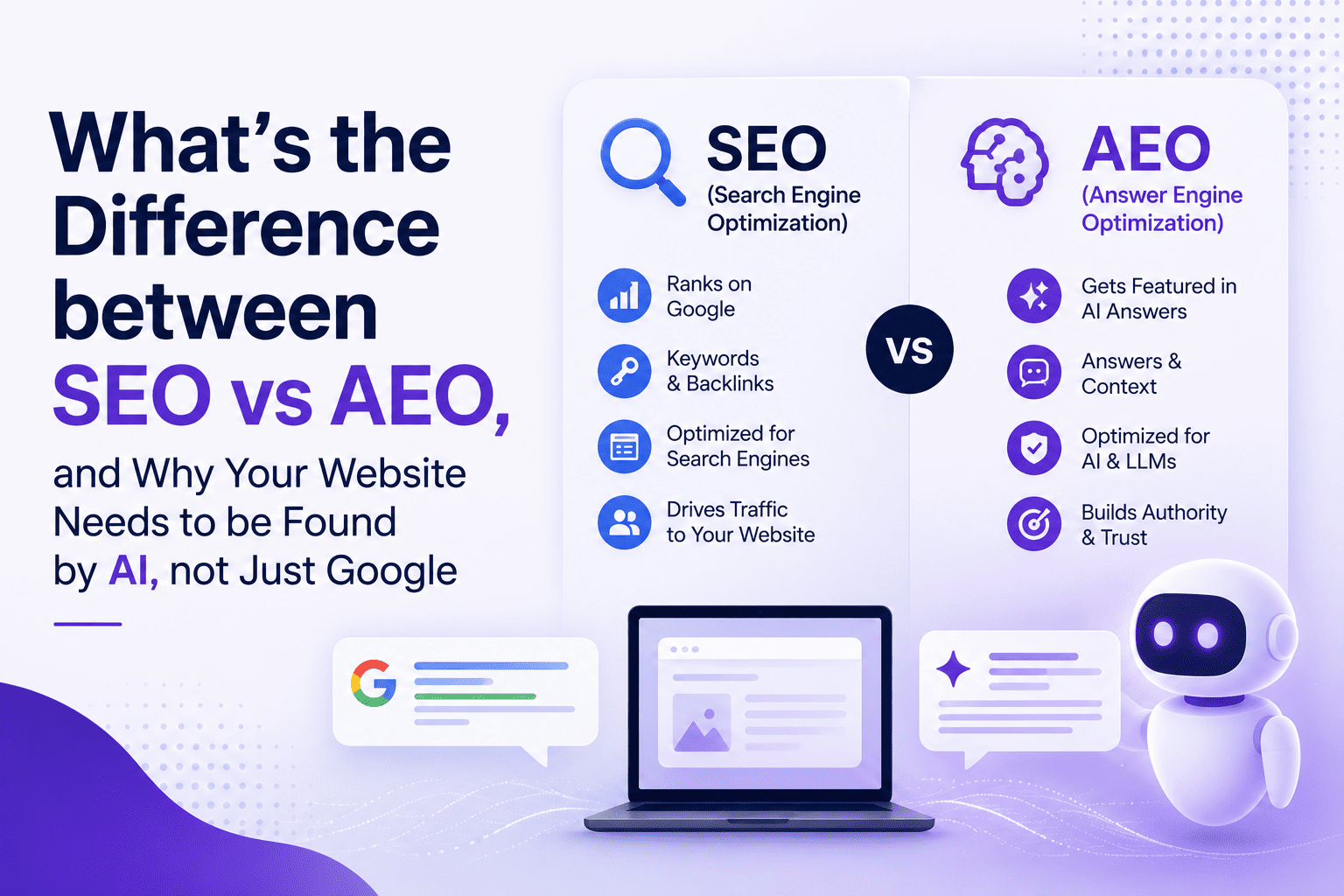
What’s the Difference between SEO vs AEO, and Why Your Website Needs to be Found by AI, not Just Google
Summary
- Search has changed, AI tools like ChatGPT, Gemini, and Perplexity are replacing Google for millions of searches
- SEO gets you ranked on Google; AEO gets you cited in AI-generated answers
- 58.5% of Google searches already end with zero clicks — users get their answer and leave
- If your website isn’t structured for AI, you’re invisible to a fast-growing share of potential customers
- The fix: structured data, clear question-and-answer content, and consistent brand information across the web
Search has changed. Not gradually, abruptly. If you’ve noticed your organic website traffic declining despite doing everything “right” by traditional SEO standards, you’re not imagining it. The rules of digital visibility have shifted, and the businesses adapting now will be the ones that get found tomorrow.
This article breaks down what’s happening, what the new acronyms actually mean, and what you need to do about it.
First, What Is SEO? (A Quick Refresher)
SEO stands for Search Engine Optimisation. It’s the practice of making your website rank higher on Google so people can find you when they search for terms related to your business. For the last two decades, this meant:
- Targeting the right keywords (e.g. “best plumber in Auckland”)
- Building backlinks (other websites linking to your website)
- Making your site technically fast and well-structured
SEO still works. But it’s no longer enough on its own.
The Problem: Google Isn’t the Only Game Anymore
Here’s what’s happening at the search level right now:
- AI Overviews now appear at the very top of Google results, before any organic listing. Even if you rank #1, an AI-generated summary often sits above you.
- SparkToro (2024) found that 58.5% of Google searches already end without a single click to an external website, users get their answer and leave.
- HubSpot, a major marketing platform, reported losing 140 million website visits in a single year due to AI overviews absorbing user attention before anyone clicked through.
And that’s just Google. Many people aren’t even Googling anymore. They’re asking ChatGPT, Claude, Gemini, or Perplexity directly. The search box is being replaced by a conversation.
How Search Behaviour Has Changed
The way people search has fundamentally shifted, not just where, but how.
| Old Search Behaviour | New Search Behaviour |
| Short keywords: “web design NZ” | Full questions: “Who’s the best web design agency in New Zealand for a small business?” |
| Browsing a list of links | Reading a synthesised AI answer |
| Clicking through to websites | Getting answers without leaving the search interface |
| Google-centric | Spread across ChatGPT, Gemini, Claude, Perplexity |
This matters because AI systems don’t rank pages, they synthesise answers. To appear in those answers, your content needs to be built differently.
Enter AEO and GEO: The New Disciplines
AEO: Answer Engine Optimisation
AEO is the practice of structuring your website content so that AI-powered answer engines can extract, cite, and feature it in their responses. Think of it as making your content “AI-readable.”
Example: If someone asks ChatGPT “What cladding material is best for a NZ coastal home?”, AEO is why one building company’s content gets cited and another’s doesn’t, even if both rank well on Google.
GEO: Generative Engine Optimisation
GEO goes one step further. It’s about building enough semantic authority around your brand or topic that AI models routinely reference you, not just occasionally. Where AEO gets you cited, GEO makes you the go-to source.
Example: A GEO-optimised mortgage broker becomes the name Perpslexity or Gemini surfaces every time someone asks about first home buyer options in New Zealand.
AIEO: AI Engine Optimisation
AIEO is the umbrella term covering all of the above; including foundational SEO, AEO, and GEO (as one unified strategy for AI-era visibility).
SEO vs AEO Comparison
| SEO | AEO / GEO | |
| Goal | Rank on Google’s results page | Get cited in AI-generated answers |
| Where it shows up | Google, Bing search results | ChatGPT, Gemini, Perplexity, AI Overviews |
| Optimised for | Search engine crawlers | Large Language Models (LLMs) |
| Content style | Keyword-focused, long-form | Question-based, clearly structured, factual |
| Key signals | Backlinks, keywords, page speed | Semantic clarity, structured data, entity authority |
| Success metric | Clicks and rankings | Citations, mentions, AI recommendations |
| Still relevant? | Yes – foundational | Yes |
What Makes a Website AI-Friendly?
Good news: a well-built SEO foundation actually helps AI visibility. Clean code, fast load times, and clear content structure all matter to AI crawlers too. But there are additional factors that AI systems specifically look for:
1. Structured Data (Schema Markup)
AI models parse structured data; code snippets embedded in your site that label your content explicitly. For example, tagging a FAQ section so an AI knows it’s a question-and-answer format, not just a paragraph. Research by Google Developers (2024) found that structured markup increases the probability of being cited in AI results by 27%.
2. Clear, Extractable Answers
AI systems prefer content that answers a question directly and immediately, not buried three paragraphs down. Content should be structured like: question → direct answer → supporting detail.
3. Entity Authority
AI models build knowledge around “entities” (brands, people, organisations, concepts). If your brand is consistently mentioned across reputable sources (directories, news, industry publications, Wikipedia), AI starts to treat you as a trustworthy reference.
Google’s Knowledge Graph data shows that brands recognised as entities are four times more likely to appear in AI-generated voice and text answers.
4. Lightweight, Crawlable Code
Heavy JavaScript, bloated page sizes, and slow load times don’t just hurt your Google rankings, they make it harder for AI systems to parse your content. A lean, well-structured site is easier for both humans and machines.
5. Consistent, Accurate Information
AI models synthesise across multiple sources. If your business name, address, services, and descriptions are inconsistent across your website, social profiles, and directories, the AI loses confidence in you as a source.
Why This Matters for Your Business Right Now
The numbers make it hard to ignore:
- 44% of consumers now use AI as their primary product research tool (McKinsey, 2024)
- 68% of B2B buyers use AI to summarise and shortlist vendors before even contacting them (Bain & Company, 2024)
- 72% of consumers trust AI recommendations for product and service decisions (Bain & Company, 2024)
If your business isn’t showing up in AI-generated answers, you’re invisible to a rapidly growing segment of your potential customers and they may never know you exist.
SEO Still Matters
To be clear: SEO isn’t dead. A well-optimised website is still the technical foundation that makes everything else possible. If AI crawlers can’t access your site efficiently, structured data won’t help. If your content is thin or generic, no amount of schema markup will save it.
Think of it as a stack:
LEVEL 1 — SEO (Search Engine Optimisation)
Your foundation: crawlable, fast, technically sound
LEVEL 2 — AEO (Answer Engine Optimisation)
Your content gets extracted and featured in AI responses
LEVEL 3 — GEO (Generative Engine Optimisation)
Consistently cited as an authority in AI answers
LEVEL 4 — AGO (AI Generation Optimisation)
Your brand becomes the default AI recommendation
You can’t shortcut to level 3 without level 1 being solid. But staying at level 1 and calling it done is leaving serious visibility on the table.
What Stylo Digital Is Doing About This
This is exactly why we’ve expanded our services beyond traditional SEO into AI visibility strategy, combining technical website optimisation with AEO and GEO content structuring.
For our clients, that means:
- Auditing your current site for AI-readiness
- Implementing structured data that AI systems can read and cite
- Restructuring content to answer the long-form questions your customers are actually asking AI tools
- Building topical authority that positions your brand as a go-to reference in your industry
Search has changed. The businesses that adapt now will be the ones AI recommends tomorrow.
Ready to find out where your website stands? Get in touch with Stylo Digital →
Sources: Gartner (2024), SparkToro (2024), Microsoft Advertising (2024), McKinsey (2024), Bain & Company (2024), Google Developers (2024), Aggarwal et al. / Princeton & Google DeepMind (2024), Pew Research Center (2025), HubSpot / BBC News (2026).