
Is Your Business Being Recommended by AI Right Now? How to Check and Track It
Summary
You find out whether AI tools recommend your business by running the real questions your customers ask — “who’s the best [your service] in [your town]?” — across ChatGPT, Perplexity and Google’s AI, repeatedly, and measuring how often your name appears. A single check is misleading, because AI answers change every time and differ by platform. To track it properly you need to measure your mention rate across platforms over time — either manually in a spreadsheet, or with a purpose-built AI-visibility tool.
Your customers are already asking AI who to hire
For two decades, “being found online” meant one thing: ranking on Google. That world is changing fast. In 2026, roughly a third of consumers now begin their searches with an AI tool rather than a traditional search engine, and ChatGPT alone passed 900 million weekly active users in February 2026 — more than double a year earlier.[1]
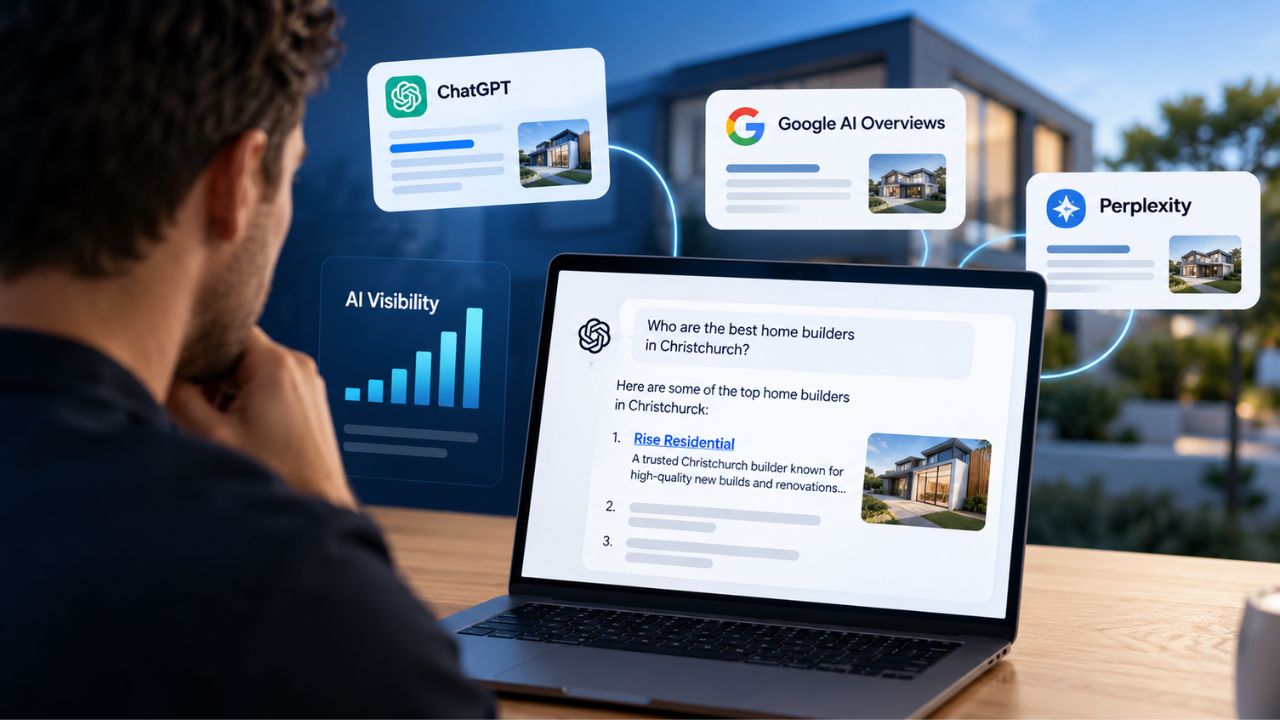
Your customers are increasingly skipping the list of blue links and simply asking — ChatGPT, Perplexity, Google’s AI Overviews, Copilot. They ask “who does the best bathroom renovations in Christchurch?” or “recommend a reliable commercial builder near Auckland,” and the AI hands back a confident, conversational answer naming a handful of businesses.
The uncomfortable question is: is your business one of the names it mentions? For B2B especially, this now sits inside the buying process — a March 2026 analysis found that almost three-quarters of B2B buyers use ChatGPT, Perplexity, Gemini or similar tools as part of their vendor research.[2]
Why you can’t just “Google yourself” to check
You might be tempted to open ChatGPT, ask “what’s the best [your service] in [your town]?”, see whether your name appears, and call it done. Don’t — that single check will mislead you, for three reasons.
1. The answer changes every time you ask
Ask the same AI the same question five times and you’ll often get five slightly different answers. These systems generate responses probabilistically, so one lucky mention doesn’t mean you’re reliably recommended — and one miss doesn’t mean you’re invisible. The volatility is real and measurable: only about 30% of brands maintain visibility between consecutive AI answers.[7] Your presence isn’t a position you hold — it’s one you have to keep earning.
2. Every AI platform answers differently
ChatGPT, Perplexity and Google’s AI each pull from different sources and reason differently, so you might be strong on one and absent on another. Best practice is to track ChatGPT, Google AI Overviews and Perplexity at minimum, and report each platform separately, because answer sets, citations and brand-recommendation behaviour differ sharply between them.[3] Checking one platform tells you almost nothing about the others.
3. The wording of the question changes who gets named
“Best builder in Hamilton” and “reliable residential builder near Hamilton” can surface completely different businesses. Your customers ask in dozens of ways, and you need to know how you perform across that whole spread — not just the one phrasing that happened to occur to you.
So a quick self-check gives you a false sense of security, or false panic. What you need is a measurement, not a spot-check.
What “AI visibility” actually measures
Here’s the simple version. If you ran the real questions your customers ask through the major AI platforms many times over, what percentage of those answers mention your business? That percentage is your AI visibility — sometimes called your mention rate or presence score.
A business with strong visibility gets named consistently: across platforms, across different phrasings, on repeated asks. A business with weak visibility gets mentioned occasionally, on one platform, if the stars align. Most SMEs, when they first measure, discover they’re closer to the second than they’d hoped — and the most common failure mode isn’t a bad review from the AI, it’s silent invisibility: the brand simply doesn’t appear in the answer at all — no hallucination, no negative framing, just absence.[4]
Why AI recommends some businesses and ignores others
AI tools don’t pick names at random. They decide who to recommend based on signals they can find and trust. Understanding these signals tells you what to fix. Five factors drive citation decisions across the major answer engines: structured authority signals from recognised sources, entity clarity in a brand’s own information, citation frequency across indexed sources, retrievability of the content, and recency of coverage.[4]
The single biggest surprise for most owners is how little their own website does the job alone. Independent studies converge on the same finding: earned media — third-party coverage — is what AI trusts most[5], with analyses putting roughly 82% to 85% of AI citations coming from third-party sources rather than brand-owned websites[6]. It also has little to do with your Google ranking — 57.1% of AI Overview sources come from outside the organic top 10, and 88% of Google AI Mode citations are pages not in the organic top 10[7]. Traditional rank-tracking simply misses most of what AI cites.
How to track whether AI recommends your business
There are two honest options.
Option 1: Track it manually
It’s possible, just painful. You’d write out 20–30 real customer questions, ask each across ChatGPT, Perplexity and Google’s AI, repeat each several times to average out the randomness, log every result in a spreadsheet, then repeat the whole exercise weekly to see trends. It works — it’s just tedious, and the moment you stop, your data goes stale.
Option 2: Use a purpose-built AI visibility tool
The systematic option is a tool built for the job. This is the exact problem we built our workflow around at Stylo Digital: we run a large, fixed set of real customer prompts across ChatGPT, Perplexity and Google on a schedule, track your mention rate over time, break the score down by platform, watch which competitors get named alongside (or instead of) you, and pinpoint why the AI isn’t picking you — thin website content, missing structured data, or a lack of earned coverage. Instead of a nervous one-off “did it mention me?”, you get a visibility score you can watch move week to week, and a prioritised list of what to fix first.
| Manual spreadsheet | Purpose-built tool | |
| Platforms covered | Whatever you check by hand | ChatGPT, Perplexity, Google — consistently |
| Repeats per question | However many you have patience for | Dozens, automatically |
| Trend over time | Only if you keep it up | Tracked continuously |
| Tells you why you’re missing | No | Yes — prioritised fixes |
| Ongoing effort | High, every week | Low |
What to do once you know your score
Measuring is step one; the point is what it tells you to do next. A proper AI-visibility audit shows you the gap, and the common culprits for NZ SMEs are consistent:
- Weak earned media — if credible third-party sites don’t mention you, AI has little reason to. This is usually the biggest lever, given how heavily engines lean on third-party sources.
- Unstructured website content — leading with a direct answer in the first 40–60 words and embedding statistics and comparisons (not just Q&A) measurably improves how AI extracts your content.[7]
- Missing structured data and FAQs — schema and FAQ sections make your content machine-parseable and easier to cite.
- No comparison or “best of” content — the exact content AI reaches for when someone asks it to recommend or compare options.
Fix the biggest gaps and, over the following weeks, you should see your mention rate climb — measurably, not hopefully.
Frequently asked questions
How do I check if ChatGPT recommends my business?
Ask ChatGPT the real questions your customers use, such as “who’s the best [your service] in [your town]?”, several times over — because answers vary between asks. One mention isn’t proof you’re reliably recommended, and one miss isn’t proof you’re invisible. For a true picture, repeat the question many times and calculate how often your name appears, then do the same on Perplexity and Google’s AI, since each platform behaves differently.
Why does AI give a different answer every time I ask?
Because AI language models generate responses probabilistically rather than returning a fixed list. In practice, only about 30% of brands hold their visibility between two consecutive AI answers. That’s exactly why a single self-check is unreliable and why measuring a mention rate across many repeats matters more than any one answer.
Is my Google ranking the same as my AI visibility?
No. They’re largely independent. The majority of sources AI engines cite sit outside the traditional organic top 10 — one analysis found 88% of Google AI Mode citations were pages not in the organic top 10. You can rank well on Google and still be invisible in AI answers, which is why AI visibility needs to be measured separately.
Why isn’t my business showing up in AI recommendations?
Usually one of four reasons: not enough credible third-party coverage (earned media), which most AI citations rely on; website content that isn’t structured for machines to extract; missing structured data or FAQ markup; or no comparison and “best of” content for the AI to draw on. An AI-visibility audit identifies which gap is hurting you most.
How often should I track my AI visibility?
At minimum, monthly — ideally weekly — because AI answers are volatile and shift as sources and models change. A one-off check is a snapshot; the value is in the trend line, so you can tell whether the fixes you make are actually moving your mention rate.
The bottom line
Your customers are already asking AI who to hire — those conversations are happening whether you’re part of them or not. The businesses that win the next few years won’t be the ones who guess. They’ll be the ones who measure their AI visibility, understand why it’s where it is, and systematically improve it. You can’t fix what you can’t see, and the first move is simply finding out where you stand.
Want to know exactly how often AI tools recommend your business — and what’s holding your score back? At Stylo Digital we run AI-visibility audits for Kiwi SMEs across ChatGPT, Perplexity and Google, and turn the findings into a clear plan of action. Get in touch for a snapshot of where your business stands.
Ngā mihi, Kevin Bach — Stylo Digital
Sources
- Instant Press — AI & ChatGPT Statistics for 2026 (consumers starting with AI; ChatGPT weekly active users). https://www.instantpress.co/ai-statistics
- Everwilde One — AI Search Statistics 2026 (share of B2B buyers using AI in vendor research). https://www.everwildeone.com/blog/ai-search-statistics/
- Parse.gl — AI search statistics 2026: the numbers that matter (track ChatGPT, AI Overviews, Perplexity separately). https://parse.gl/blog/ai-search-statistics-2026
- Everything-PR — Answer Engines: How AI Cites Brands (five citation factors; silent invisibility). https://everything-pr.com/answer-engines-how-ai-decides-which-brands-get-cited
- Muck Rack — Earned media still drives AI citations (earned media is what AI trusts). https://muckrack.com/blog/what-is-ai-reading-may-2026
- AuthorityTech — AI Citation: How Answer Engines Choose Sources (82–85% of citations from third-party sources). https://authoritytech.io/blog/ai-citation-how-answer-engines-choose-sources-2026
- AuthorityTech — How AI Answer Engines Choose Sources to Cite (visibility volatility; answer-first passages; citations outside top 10). https://authoritytech.io/curated/how-ai-answer-engines-choose-sources-to-cite-2026
Statistics current as at July 2026; figures are drawn from third-party industry research and cited above.